









FEMALE MONSTERS
While studying in the bachelor’s program of the Art Academy of Latvia, I presented some small ink drawings depicting overt sexual bodies at a semester show. Grinning broadly, a lecturer from the Department of Painting loudly asked me: “Has someone hurt you?” The other members of the committee, all men, chuckled. Obviously, no one was expecting a serious answer from me. It was a “joke,” an attempt to simplify the viewing and evaluation of my work, while depriving me of the opportunity to seriously explain the chosen themes and compositions.
Back in high school, after a wild party, a young man said to me, “There are girls that I am with, and then there are girls like you…”. For a long time, I buried this phrase in my subconscious, but over the past three years, while studying the origins of feminine-monster myths, it has come back to nag me.
Thinking about this and many other professional and private insults, I have realised they have given me the strength to continue exploring the subject of sexuality. This initial impulse of defiance has evolved over more than a decade into a process of artistic exploration, culminating in the study of ancient Greek myths and archaeological artifacts conducted as part of a professional doctorate, focusing specifically on Medusa, Pandora and the Sirens. These sexualized monsters are an integral part of the phallocentric narratives of Western culture and psychoanalysis. I observed with immense interest how the myth travelled from the ancient world to the present, affecting my life as well as many other women.
Investigating how these horrific monsters arose, unsurprisingly, they were most often born from acts of violence and subjugation by men (gods or mortals). The element of being punished for one’s sexuality and body is present to some extent in all the myths I have studied. And what these beautiful, strong beings do afterwards to survive or regain their autonomy frightens the male gaze even more, and the demonization morphs into new mythologies of fear.
The legendary beauty Medusa, one of the three Gorgon sisters, is raped in the temple of Athens by the sea god Poseidon. However, it is Medusa herself rather than her abuser who is punished. The goddess Athena turns her beautiful hair into snakes, and her irresistible gaze becomes a deadly weapon. Anyone who looks into Medusa’s eyes turns to stone. The horrific power of her gaze extends beyond death as well. When the hero Perseus, looking at the reflection of Medusa in the shield, cuts off her head, it becomes the first “apotropaic sign”: Athena wears it on her breastplate to repel her enemies. (AΠΟTROPΑΙΟΣ – from the ancient Greek verb apotrepo – “to turn away”).
An apotropaic sign is created by picking up what you are most afraid of and pointing it at your enemy. Maybe that’s what I’ve tried to do with the help of art – I’ve been looking for a sign that would break the power of the centuries-old, incriminating hero’s gaze.
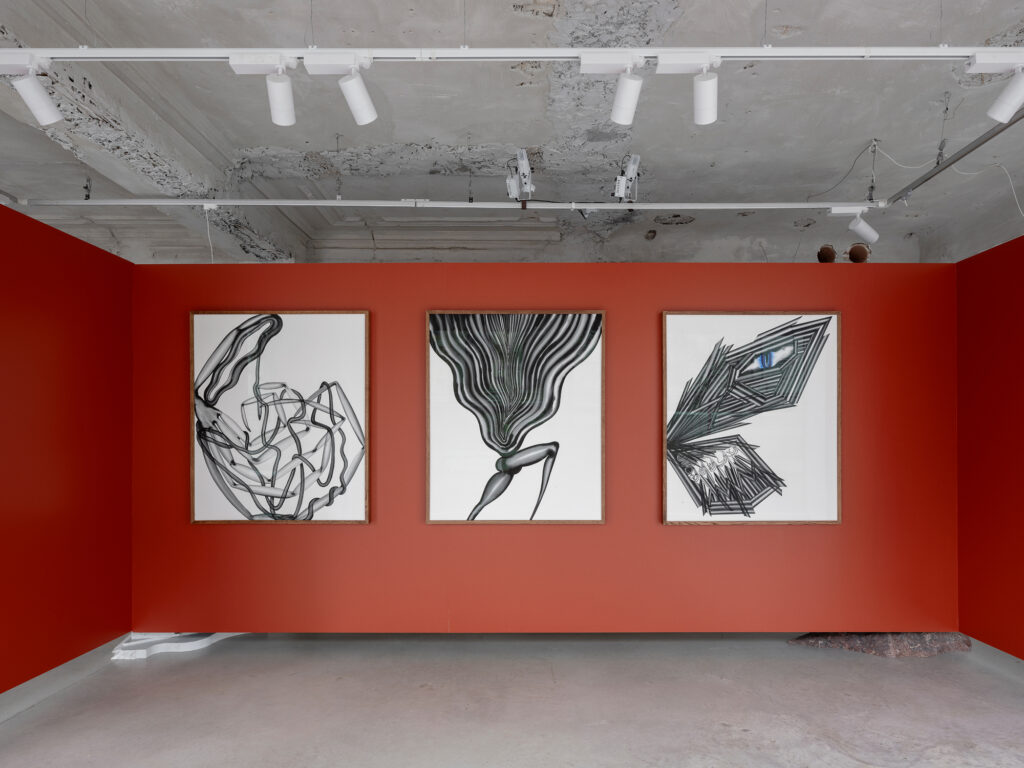
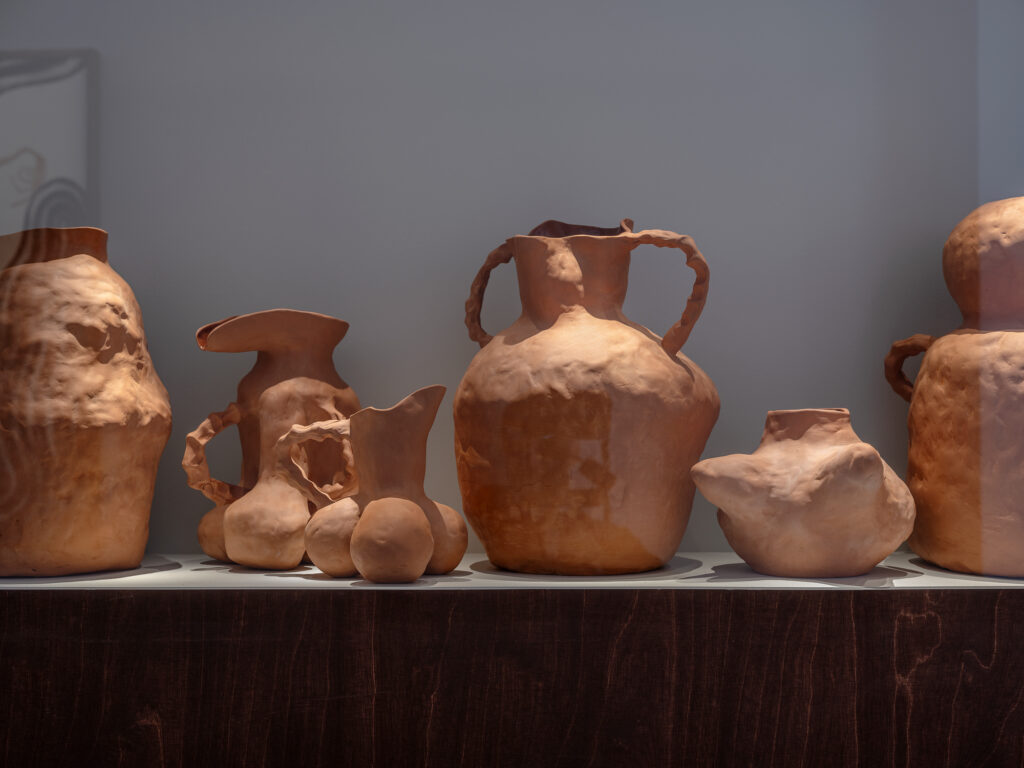
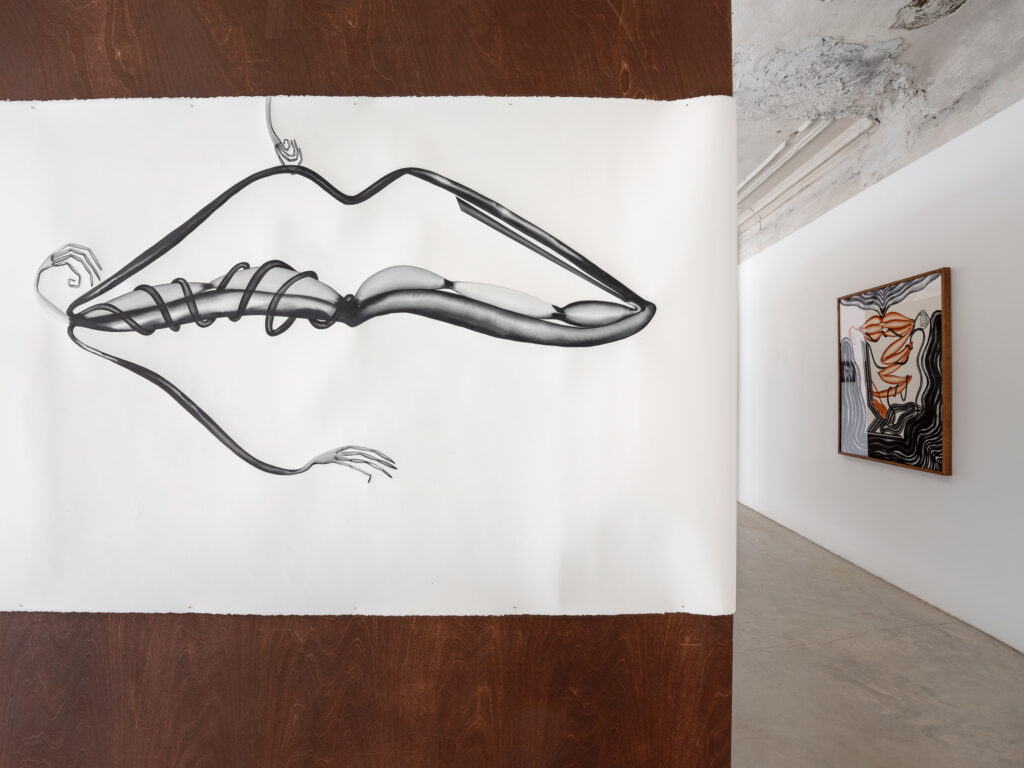
However, we do not have to forever define ourselves in relation to the condemnation, lust or violence of others, even if civilization has done so from Ancient Greece to the present day. In my final professional doctoral exhibition, I have reflected on escaping from the dark mirrors and shields of the patriarchy in ink and egg tempera paintings, ceramics and marble. Before you are beings who refuse to be “signs”. They dance, sing and grow, laughing their Medusa’s laughter*, flourishing in a free, defiant and eternal joy of life.
Sabīne Vernere, March 28, 2025.
*From Helene Cixous’ 1975 essay “The Laugh of the Medusa”.